If your platform serves gyms, salons, spas, barbershops, or any business where people earn commission on top of an hourly wage, there's a compliance trap sitting inside your payroll product that most teams never think about. It's small enough to miss on every paycheck and expensive enough to end up in an expensivelawsuit. And in California, it's one of the fastest ways for a platform to turn a few cents of error into six figures of liability. Per employer. Spread across every customer you have.
It comes down to one deceptively simple question: when an employee earns both hourly pay and commission, what rate do you use to calculate their overtime?
Most people assume the answer is "1.5× their hourly wage." It isn't. And getting it wrong is easier than you'd think.
Overtime isn't 1.5× the hourly wage
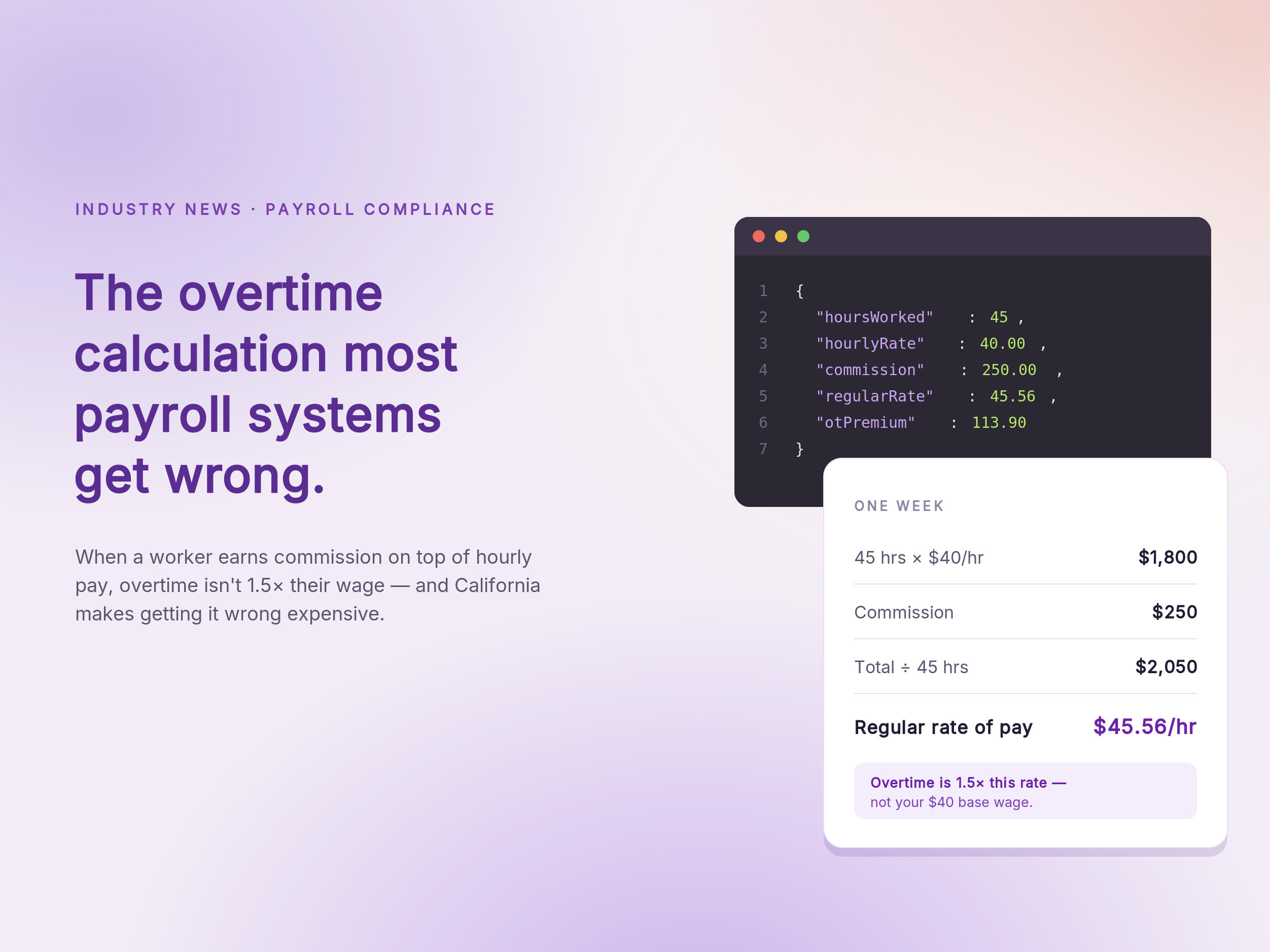
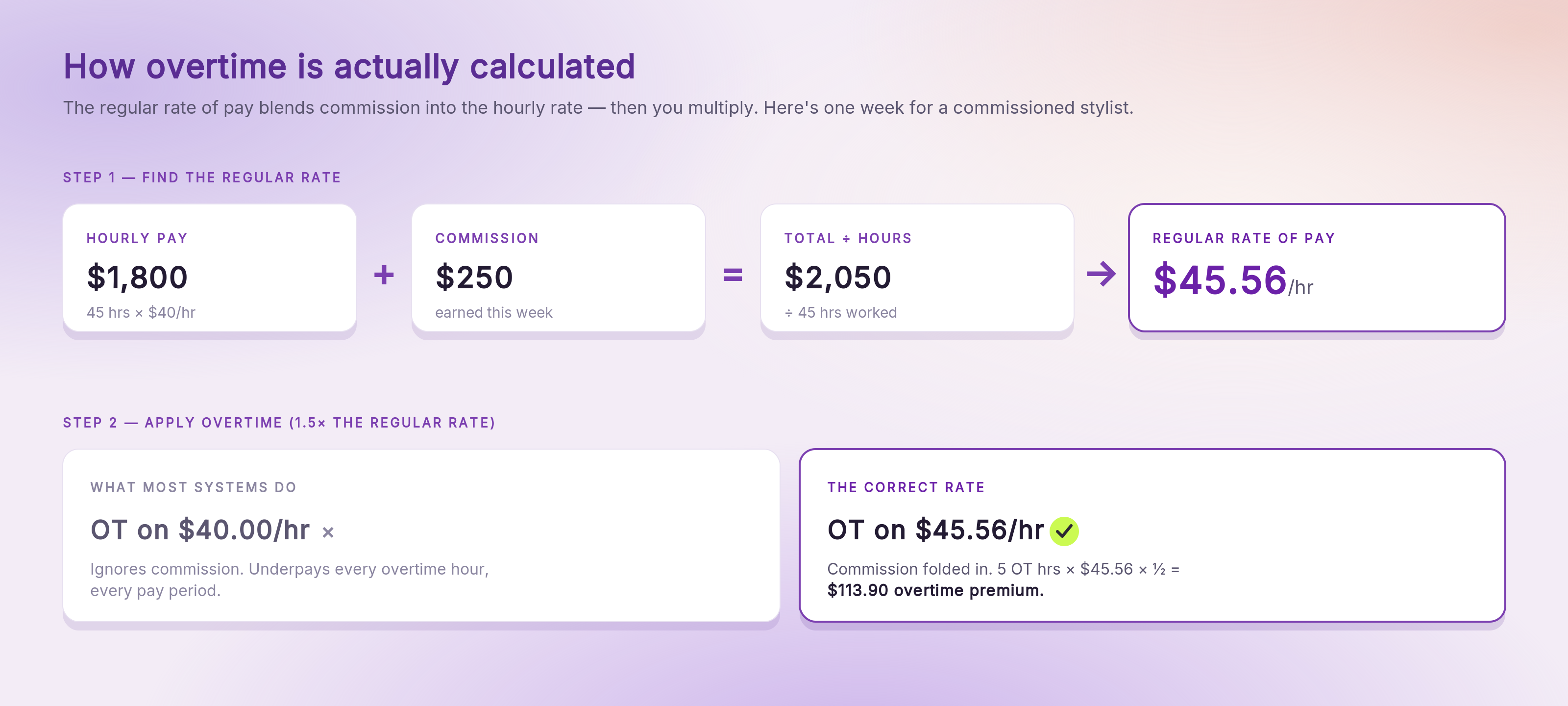
Under the federal Fair Labor Standards Act — so, in all 50 states — overtime is 1.5× the regular rate of pay. That's not the same thing as the base hourly wage. The regular rate is total weekly earnings, including commissions and nondiscretionary bonuses, divided by the total hours worked. Commission has to be folded in before you multiply.
Here's what that looks like for a stylist who worked a busy week:
- 45 hours at $40/hour = $1,800
- Commission earned that week = $250
- Total weekly earnings = $2,050
- Regular rate = $2,050 ÷ 45 = $45.56/hour
- Overtime premium = 5 overtime hours × $45.56 × ½ = $113.90
If your system ignores the commission, it calculates overtime on $40/hour instead of $45.56. The gap is a few dollars — this week. But it repeats every pay period, for every commissioned worker, quietly, forever. And the error is largest for your best earners: the stylists and technicians pulling the most commission are exactly the ones most likely to notice, and to do something about it.
In California, a rounding error becomes a lawsuit
In most states, an underpaid employee who wants that money back has to hire their own lawyer and prove actual damages. A few dollars a paycheck almost never justifies the effort, so the vast majority of regular-rate errors simply stay buried.
California is different, and the difference has a name: PAGA, the Private Attorneys General Act.
Under PAGA, a single employee can sue on behalf of the state and every one of their coworkers — acting as a "private attorney general." The penalties are statutory: $100 per employee, per pay period (even more for repeat or willful violations), stacking across the entire year and the entire staff. The size of the underpayment is irrelevant. A five-cent weekly miss across a team of employees, compounded over a year of payrolls, can land in six-figure territory.
Now scale that thought up. If a plaintiff's attorney discovers that the error isn't in one salon's setup but baked into the payroll product every salon on your platform is using, they don't stop at one. They go salon to salon, collecting penalties across your whole customer base. One flawed calculation becomes a catastrophic liability.
There's a flip side worth knowing, and it's good news. California's 2024 PAGA reform sharply reduces — or eliminates — penalties for employers who took "reasonable steps to comply." Running payroll on a system that computes the regular rate correctly, every workweek, is precisely that kind of reasonable step. Getting this right isn't just about avoiding the mistake. It's the thing that caps the downside if anyone ever comes looking.
Why it's genuinely hard to get right
If this were easy, everyone would already do it. It isn't. A correct overtime engine has to handle a stack of realities that don't line up neatly:
The regular rate is calculated per workweek — a fixed seven-day window — even when you run payroll bi-weekly, semi-monthly, or monthly. You can't just take a $3,000 bi-weekly commission and split it evenly; you have to know which week the work happened.
That means each commission has to be attributed to the week it was actually earned. Land it in the wrong week and the blended rate is wrong, and so is the overtime.
States then layer their own rules on top of the federal 40-hour standard. California alone adds daily overtime (over 8 hours, and again over 12), plus a seventh-consecutive-day rule — all applied to the same hours without double-counting any of them.
And because pay periods and workweeks rarely share the same calendar, a single workweek routinely spans two pay periods and has to be stitched back together so the hours count toward one overtime threshold.
None of these is exotic on its own. Together, they're the kind of thing that takes a team of payroll and engineering experts months to build correctly — and a long time to trust.
This is exactly what embedded payroll should handle
This is the whole premise of building payroll into the software a business already runs on. The platform knows when a stylist worked, what they earned in hourly pay, and what they earned in commission — all in one place. The overtime calculation shouldn't be a landmine the business steps on later. It should just be right.
That's why we built Salsa's overtime engine to handle the regular rate of pay out of the box — commissions and bonuses folded in, per workweek, with state-specific rules for the US and Canada. Your customers stay compliant without becoming payroll experts, and your platform doesn't inherit a liability that multiplies across every account.
Payroll is full of details like this — quiet, unglamorous, and enormously consequential when they're wrong. Getting them right is the difference between a payroll product your customers trust and one that becomes someone's lawsuit. If you're building payroll into your platform and want it done right, let's talk.
Stay in the know
Sign up to receive regular product updates highlighting our feature announcements and product enhancements.
.png)


.png)